

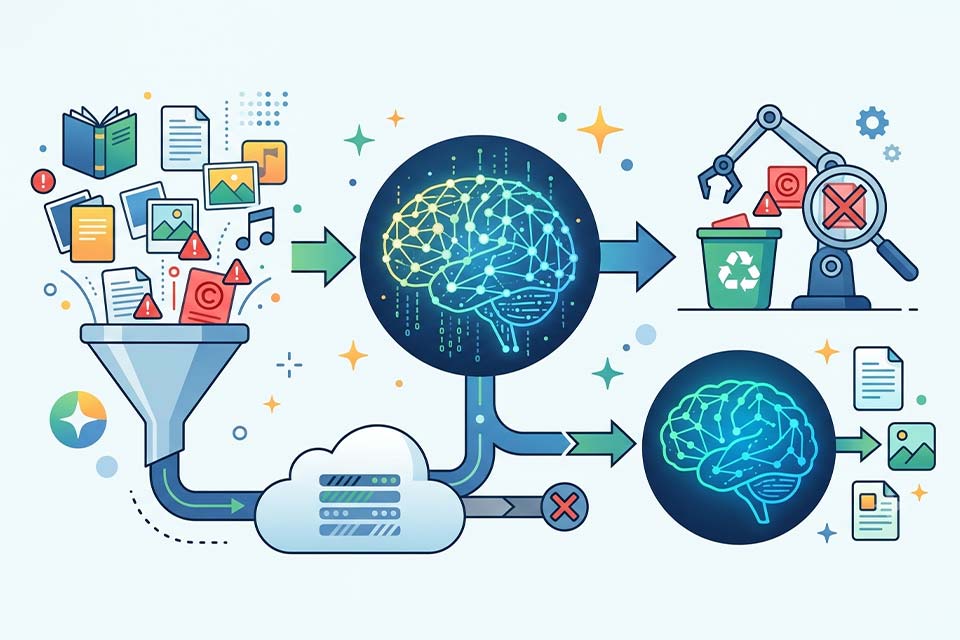

You educated on knowledge it is best to have excluded. Now the query is tougher than deletion as a result of the mannequin could have absorbed patterns, phrases, non-public information, or copyrighted materials throughout its weights.
Machine unlearning tech offers groups a sensible approach to take away the affect of chosen knowledge with out rebuilding each mannequin from zero. It helps you reply to privateness requests, copyright claims, licensing errors, and governance gaps whereas defending helpful mannequin habits throughout authorised duties.
Why can deleting supply recordsdata fail to resolve the issue?
Retraining a big AI mannequin from scratch sounds simple, but it may be costly, gradual, and tough to repeat for every removing request. A single copyright declare, consent withdrawal, or privateness grievance could have an effect on a small slice of knowledge.
Deleting the supply file additionally doesn’t take away realized affect from the educated mannequin. Analysis on machine unlearning focuses on eradicating the consequences of chosen knowledge with out full retraining, which makes the strategy vital for giant AI techniques.
Additionally Learn: AIThority Interview With Rohit Agarwal, Founder & CEO of Portkey
What does selective forgetting imply in neural networks?
Selective forgetting goals to take away the impression of chosen knowledge whereas protecting the mannequin helpful for authorised duties.
- Machine unlearning tech targets particular examples, authors, information, or content material teams that require removing.
- The mannequin receives an unlearning request, then updates weights, outputs, retrieval layers, or security filters.
- Sturdy strategies attempt to scale back memorized content material with out damaging normal reasoning or language high quality.
- Researchers describe machine unlearning as eradicating particular information whereas preserving efficiency on unrelated duties.
How does Machine Unlearning Tech assist the proper to be forgotten?
Privateness guidelines such because the GDPR give folks the proper to request the erasure of private knowledge in sure circumstances. AI creates a tough downside as a result of private knowledge could affect educated fashions after supply information disappear.
Machine unlearning tech may help bridge this hole by decreasing the mannequin’s dependence on deleted information. The European Information Safety Supervisor notes that unlearning alone can not assure the proper to be forgotten, so proof, audits, and privateness leak checks stay wanted.
How do you take away delicate knowledge with out breaking efficiency?
Scrubbing dangerous knowledge requires a transparent course of that separates removing from wider mannequin harm.
1. Information Mapping:
Determine the precise works, information, authors, consumer profiles, or fields that should be eliminated. Broad deletion can weaken mannequin worth.
2. Affect Tracing:
Estimate the place the eliminated knowledge formed mannequin outputs, memorized strings, embeddings, or retrieval outcomes. This step guides focused correction.
3. Managed Replace:
Apply unlearning, mannequin modifying, retraining on clear knowledge, or retrieval removing. The appropriate technique depends upon mannequin design.
4. Efficiency Testing:
Evaluate the up to date mannequin in opposition to protected benchmark duties. The objective is removing with out main loss throughout authorised use circumstances.
Why does unlearning want its personal management layer?
The mannequin modifying layer sits between governance groups and deployed AI techniques. It information removing requests, maps affected belongings, applies updates, exams outputs, and shops proof for overview.
This layer could embrace knowledge lineage instruments, unlearning workflows, analysis suites, coverage controls, and launch gates. Machine unlearning tech turns into extra helpful when groups deal with it as an operational functionality, reasonably than a one-time analysis repair.
Over time, this layer can assist copyright response, privateness compliance, dangerous knowledge removing, and mannequin correction. It turns into a part of accountable AI upkeep.
How can groups show the information is gone?
Proof issues since you can not present a regulator a mannequin’s reminiscence in a easy file folder.
- Run extraction exams to examine whether or not the mannequin nonetheless reproduces eliminated textual content, names, or non-public knowledge.
- Use membership inference exams to see whether or not eliminated samples nonetheless seem mirrored in mannequin habits.
- Keep audit logs displaying request consumption, knowledge scope, technical technique, validation outcomes, and approval historical past.
- Evaluate outputs earlier than and after unlearning to indicate diminished dependence on the eliminated materials.
- The EDPS highlights verifiable proof of unlearning and audits as wanted safeguards.
The place can Machine Unlearning Tech fall brief?
Machine unlearning tech is beneficial, but it doesn’t remove all authorized or moral dangers by itself. Fashions could maintain oblique patterns from comparable knowledge, and downstream copies should still exist throughout caches, APIs, logs, or fine-tuned variations.
Unlearning also can have an effect on mannequin efficiency if the eliminated knowledge overlaps with helpful information. Current analysis notes the problem of fine-grained forgetting whereas defending era high quality, particularly in language fashions.
Can AI have a delete button for reminiscence?
Machine unlearning tech offers AI groups a path towards an actual delete button for mannequin reminiscence. It can not exchange clear knowledge sourcing, licensing self-discipline, consent administration, and robust governance, but it could scale back hurt after issues floor.
For AI leaders, the message is evident. Construct fashions with traceable knowledge, detachable information paths, and testable deletion controls from the beginning. That’s the way you make forgetting a part of the AI stack reasonably than a disaster response.
Additionally Learn: AI-Pushed Threat Intelligence: How FIs Are Predicting Systemic Shocks
[To share your insights with us, please write to psen@itechseries.com]
