


The expectations from information professionals have modified considerably. Past analyzing historic information and constructing dashboards, organizations now search professionals who can leverage AI to generate insights, automate workflows, and remedy advanced enterprise issues.
In response to the World Financial Discussion board’s Way forward for Jobs Report 2025, AI and massive information rank because the fastest-growing expertise globally, whereas 86% of employers count on AI and data processing applied sciences to rework their enterprise by 2030.
This shift is growing demand for information professionals who can mix analytics with AI experience.
This text explores the important thing AI expertise for information professionals, how the position is evolving past conventional analytics, and the sensible capabilities wanted to construct a profitable profession in AI and information science.
What Are AI Expertise for Knowledge Professionals?
AI expertise for information professionals mix conventional information evaluation with machine studying, generative AI, programming, and enterprise problem-solving to ship actionable insights and clever options.
Not like conventional information roles that centered totally on gathering, cleansing, and analyzing information, at this time’s professionals are anticipated to construct clever techniques, automate workflows, and assist organizations make AI-driven choices.
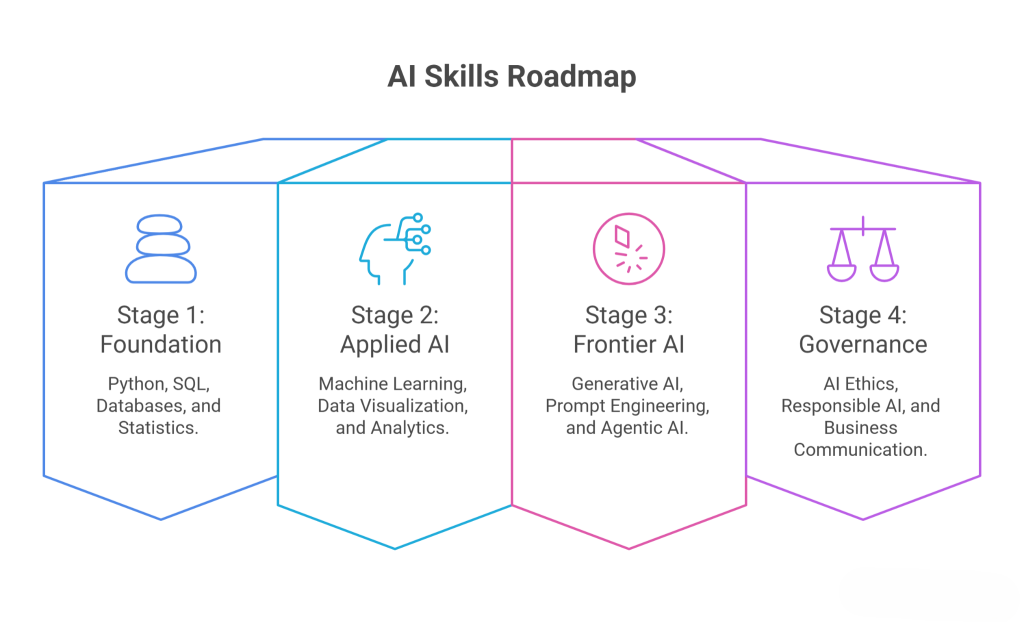
A sensible studying journey appears to be like like this:
| Studying Stage | Key Expertise | Estimated Time* |
| Stage 1: Basis | Python programming, SQL, Database Administration, statistics, information manipulation | 4–8 weeks |
| Stage 2: Utilized AI & Analytics | Machine Studying Fundamentals, Knowledge Visualization, mannequin analysis, enterprise analytics | 6–10 weeks |
| Stage 3: Frontier AI Expertise | Generative AI, Immediate Engineering, AI brokers, Agentic AI workflows, LLM purposes | 4–8 weeks |
| Stage 4: AI Governance & Enterprise Affect | AI ethics, governance, accountable AI, stakeholder communication, enterprise problem-solving | 2–4 weeks |
*Estimated timelines assume part-time studying of roughly 8–10 hours per week.
For instance, as a substitute of spending hours making ready weekly experiences, a contemporary information skilled can use AI to automate information cleansing, generate summaries, construct interactive dashboards, and give attention to deciphering insights that drive enterprise choices.
Following this structured roadmap helps professionals develop each the technical and strategic capabilities wanted for AI-powered roles.
Why Knowledge Professionals Want AI Expertise Past Conventional Analytics
Conventional analytics explains what occurred. Trendy AI allows information professionals to foretell outcomes, automate choices, and construct clever purposes utilizing giant language fashions (LLMs) and AI brokers.
Organizations are quickly shifting past dashboards and descriptive reporting. As we speak’s information groups are anticipated to construct AI-powered options that automate workflows, retrieve information from enterprise information, and help enterprise choices in actual time.
AI adoption continues to develop. In response to McKinsey’s State of AI 2025, 88% of organizations now use AI in a minimum of one enterprise perform, making AI, machine studying, and generative AI expertise more and more worthwhile for information professionals.
As we speak’s employers are on the lookout for professionals who can work with trendy AI frameworks and instruments equivalent to:
- LLMs like Claude and GPT fashions for evaluation, summarization, and resolution help
- Retrieval-Augmented Era (RAG) to construct AI purposes utilizing enterprise information bases
- AI agent frameworks equivalent to LangGraph for orchestrating multi-step reasoning and autonomous workflows
- Workflow automation platforms like n8n to attach AI with enterprise techniques and automate repetitive processes
- Machine studying and predictive analytics for forecasting, anomaly detection, and personalization
- Immediate engineering and AI analysis to enhance mannequin accuracy, reliability, and enterprise outcomes
Slightly than merely analyzing historic information, trendy AI techniques can perceive context, retrieve related data, generate insights, and take actions throughout linked purposes.
| Conventional Analytics | Trendy AI-Powered Analytics |
| Explains previous efficiency | Predicts future outcomes |
| Guide reporting | AI-assisted perception era |
| Static dashboards | Conversational AI interfaces |
| Descriptive evaluation | Predictive and prescriptive intelligence |
| Remoted information evaluation | RAG-powered enterprise information retrieval |
| Standalone scripts | AI brokers and automatic workflows |
For instance, a retail analyst can nonetheless establish final month’s best-selling merchandise utilizing conventional analytics.
With trendy AI, the identical skilled can construct a RAG-powered assistant that solutions enterprise questions utilizing firm information, use LangGraph to orchestrate inventory-optimization workflows, automate reporting with n8n, and leverage Claude or GPT fashions to generate executive-ready insights.
As AI turns into embedded throughout enterprise analytics, professionals who perceive machine studying, generative AI, RAG, AI brokers, workflow automation, and LLM software growth will likely be higher positioned to construct clever information merchandise slightly than merely analyze information.
Core AI Expertise Each Trendy Knowledge Skilled Ought to Study
Constructing a profitable AI profession requires greater than studying machine studying algorithms. Trendy information professionals want a mix of technical, analytical, and enterprise expertise.
Slightly than mastering each new AI device, professionals ought to give attention to creating foundational expertise that stay worthwhile throughout industries and applied sciences.
| Talent | Why It Issues |
| Python | Construct AI, machine studying, and information science purposes |
| SQL | Question, remodel, and handle structured information |
| Machine Studying & Statistics | Develop predictive fashions and validate outcomes |
| Knowledge Visualization | Talk insights via dashboards and experiences |
| Generative AI (ChatGPT, Claude, Gemini) | Analyze information, generate insights, and automate on a regular basis workflows |
| Immediate Engineering & AI Coding Assistants (GitHub Copilot, Cursor) | Enhance LLM outputs and speed up coding, debugging, and documentation |
| Agentic AI, RAG & Workflow Automation (LangGraph, CrewAI, n8n) | Construct autonomous AI workflows and enterprise AI purposes utilizing enterprise information |
| Cloud Platforms | Deploy and scale AI purposes |
| Enterprise Understanding | Translate enterprise issues into AI-driven options |
For example, a knowledge scientist creating a buyer churn mannequin should not solely construct an correct machine studying mannequin but additionally clarify its predictions to enterprise stakeholders and suggest sensible actions.
Growing this mixture of technical and enterprise capabilities helps professionals create AI options that ship measurable impression slightly than merely producing correct predictions.
How Generative AI Is Altering Knowledge Science Workflows
Generative AI helps information professionals automate repetitive duties, speed up evaluation, and focus extra on fixing enterprise issues slightly than guide information processing.
How Generative AI Is Remodeling Knowledge Science Workflows
Generative AI is remodeling information science workflows by automating repetitive duties, accelerating evaluation, and enabling information professionals to give attention to higher-value enterprise choices.
Conventional information science tasks typically require important time to write down SQL queries, clear datasets, doc code, create experiences, and interpret outcomes.
As we speak, generative AI and AI brokers can help all through all the analytics lifecycle, serving to professionals full these duties sooner whereas sustaining human oversight.
Knowledge professionals now use generative AI to:
- Generate SQL queries and Python code
- Summarize and discover datasets
- Clarify analytical leads to plain language
- Create experiences, dashboards, and documentation
- Speed up exploratory information evaluation
- Automate repetitive analytics workflows
For instance, a contemporary AI-assisted analytics workflow can automate a lot of the reporting course of:
- Retrieve information from databases or cloud warehouses.
- Validate information high quality by checking for lacking values, anomalies, and inconsistencies.
- Analyze the info to establish developments, patterns, and key enterprise insights.
- Draft a report with visualizations, summaries, and suggestions.
- Route the report back to a supervisor or stakeholder for overview and closing approval earlier than it’s shared.
By automating routine duties, generative AI allows information professionals to spend extra time deciphering outcomes, fixing enterprise issues, and making data-driven suggestions. Nevertheless, human experience stays important for validating outputs, guaranteeing information high quality, and making use of enterprise context earlier than choices are made.
Why Enterprise and Communication Expertise Matter in AI and Knowledge Science
Technical experience alone is now not sufficient. Knowledge professionals should additionally talk insights clearly and join AI options to enterprise targets.
Because of this enterprise communication is turning into as essential as technical experience. In response to Gartner, a minimum of 50% of generative AI tasks had been deserted after the proof-of-concept stage because of unclear enterprise worth, poor information high quality, insufficient threat controls, or rising prices.
Professionals who can translate AI insights into clear enterprise outcomes are higher positioned to drive profitable AI adoption.
Essential enterprise expertise embody:
- Enterprise problem-solving
- Knowledge storytelling
- Communication
- Stakeholder administration
- Crucial pondering
- Choice-making
- Collaboration
Think about a knowledge scientist constructing a gross sales forecasting mannequin. Delivering the mannequin is just a part of the job. In addition they want to clarify why gross sales might change, what elements affect the predictions, and the way enterprise groups ought to act on these insights.
The power to translate AI outputs into sensible enterprise suggestions is turning into some of the worthwhile expertise in trendy information roles.
Frequent Talent Gaps Holding Knowledge Professionals Again
Many information professionals have sturdy analytical foundations however wrestle to maintain tempo with the fast evolution of AI applied sciences.
Conventional analytics expertise stay worthwhile, however organizations more and more count on professionals to grasp trendy AI instruments, automation frameworks, and manufacturing workflows.
Frequent talent gaps embody:
- Restricted machine studying information
- Little expertise with generative AI
- Weak software program engineering practices
- Restricted cloud platform expertise
- Issue deploying AI fashions
- Lack of enterprise communication expertise
- Minimal publicity to real-world AI tasks
For instance, knowledgeable could also be extremely expert in SQL and dashboard growth however have little expertise integrating giant language fashions into enterprise purposes or deploying machine studying options in manufacturing.
Addressing these gaps helps professionals transition from reporting historic insights to constructing clever, AI-driven options.
How Knowledge Professionals Can Construct AI Expertise Successfully
Growing AI expertise requires greater than studying particular person instruments. It entails constructing a powerful basis in information science, machine studying, and real-world AI purposes via constant observe.
An efficient studying path ought to embody:
- Python programming
- Statistics and chance
- Machine studying
- Deep studying fundamentals
- Generative AI
- Knowledge engineering fundamentals
- Cloud platforms
- MLOps and deployment
- Actual-world AI tasks
Engaged on sensible tasks is equally essential. Constructing advice techniques, predictive fashions, AI-powered dashboards, and generative AI purposes helps professionals perceive how AI strategies are utilized to actual enterprise challenges.
For professionals looking for structured studying, the AI and Knowledge Science course from MIT Skilled Schooling provides a complete curriculum that covers AI, machine studying, deep studying, generative AI, information engineering, and hands-on {industry} tasks.
By combining technical depth with sensible software, this system helps learners construct production-ready expertise for contemporary AI and information science roles.
Profession Alternatives for AI-Prepared Knowledge Professionals
Professionals who mix analytics with AI expertise are properly positioned for a rising vary of roles throughout industries.
Organizations are on the lookout for professionals who can remodel information into clever enterprise options slightly than merely reporting historic developments.
Profession alternatives embody:
| Position | Main Duty | International Outlook |
| Knowledge Scientist | Construct predictive and AI-driven fashions | Excessive demand throughout finance, healthcare, retail, and know-how |
| AI Engineer | Develop clever AI purposes | One of many fastest-growing AI roles worldwide |
| Machine Studying Engineer | Practice and deploy ML fashions | Sturdy demand as organizations transfer AI fashions into manufacturing |
| Utilized AI Engineer | Construct manufacturing AI and GenAI options | Quickly rising with enterprise GenAI adoption |
| Knowledge Engineer | Develop scalable information pipelines | Important for contemporary AI and analytics infrastructure |
| Analytics Marketing consultant | Use AI to resolve enterprise issues | Rising demand for AI transformation initiatives |
| AI Product Analyst | Assist AI-enabled product growth | Rising demand as AI-powered merchandise turn into mainstream |
As AI adoption continues throughout industries, professionals with experience in each analytics and AI will likely be higher outfitted to steer data-driven innovation and create long-term enterprise worth.
Last Ideas
Trendy information professionals want greater than analytics expertise to remain aggressive. As AI turns into an integral a part of information workflows, combining analytical experience with machine studying, generative AI, and enterprise problem-solving will likely be important for delivering larger enterprise worth.
For professionals trying to construct these in-demand capabilities, the AI and Knowledge Science course by MIT Skilled Schooling provides a structured 15-week studying path with hands-on tasks, equipping learners with sensible expertise in AI, machine studying, and information science for the following era of AI-driven careers.
Ceaselessly Requested Questions
1. What AI expertise ought to trendy information professionals study?
Trendy information professionals ought to construct a powerful basis in Python, SQL, statistics, and machine studying earlier than increasing into generative AI, immediate engineering, AI brokers, cloud platforms, and enterprise communication. This mixture allows professionals to develop AI-powered options that remedy actual enterprise issues.
2. What is the distinction between Generative AI and Agentic AI?
Generative AI focuses on creating content material, writing code, summarizing data, and answering questions primarily based on person prompts. Agentic AI goes a step additional by planning, reasoning, and executing multi-step duties with minimal human intervention. For information professionals, Agentic AI can automate workflows equivalent to retrieving information, validating outcomes, producing experiences, and routing outputs for approval.
3. How lengthy does it take to turn into job-ready in AI and information science?
The timeline will depend on your background and studying tempo. Professionals with programming or analytics expertise can typically turn into job-ready inside a number of months via structured studying and hands-on tasks, whereas freshmen might require extra time to construct foundational expertise in Python, SQL, statistics, and machine studying.
4. Do I want a pc science diploma to transition into an AI position?
No. Many professionals efficiently transition into AI from backgrounds equivalent to information analytics, engineering, arithmetic, finance, and enterprise. Employers usually worth sensible expertise, real-world tasks, and the flexibility to resolve enterprise issues greater than a selected tutorial diploma.
5. What instruments ought to information professionals study first?
Begin with Python and SQL, as they kind the inspiration of most AI and information science workflows. When you’re snug with these applied sciences, study machine studying, information visualization, and generative AI instruments equivalent to ChatGPT or Claude earlier than progressing to AI brokers and enterprise AI frameworks.
6. Which industries are hiring AI-ready information professionals?
AI-ready information professionals are in demand throughout healthcare, finance, retail, manufacturing, know-how, telecommunications, logistics, and consulting. Organizations throughout these industries are adopting AI to automate processes, enhance decision-making, and construct clever services.
7. Which AI and Knowledge Science course is appropriate for working professionals?
Working professionals ought to search for applications that mix AI fundamentals, machine studying, and generative AI with hands-on tasks that apply to real-world enterprise purposes. The AI and Knowledge Science course from MIT Skilled Schooling supplies a structured studying path to assist professionals construct sensible, industry-relevant AI and information science expertise.
