

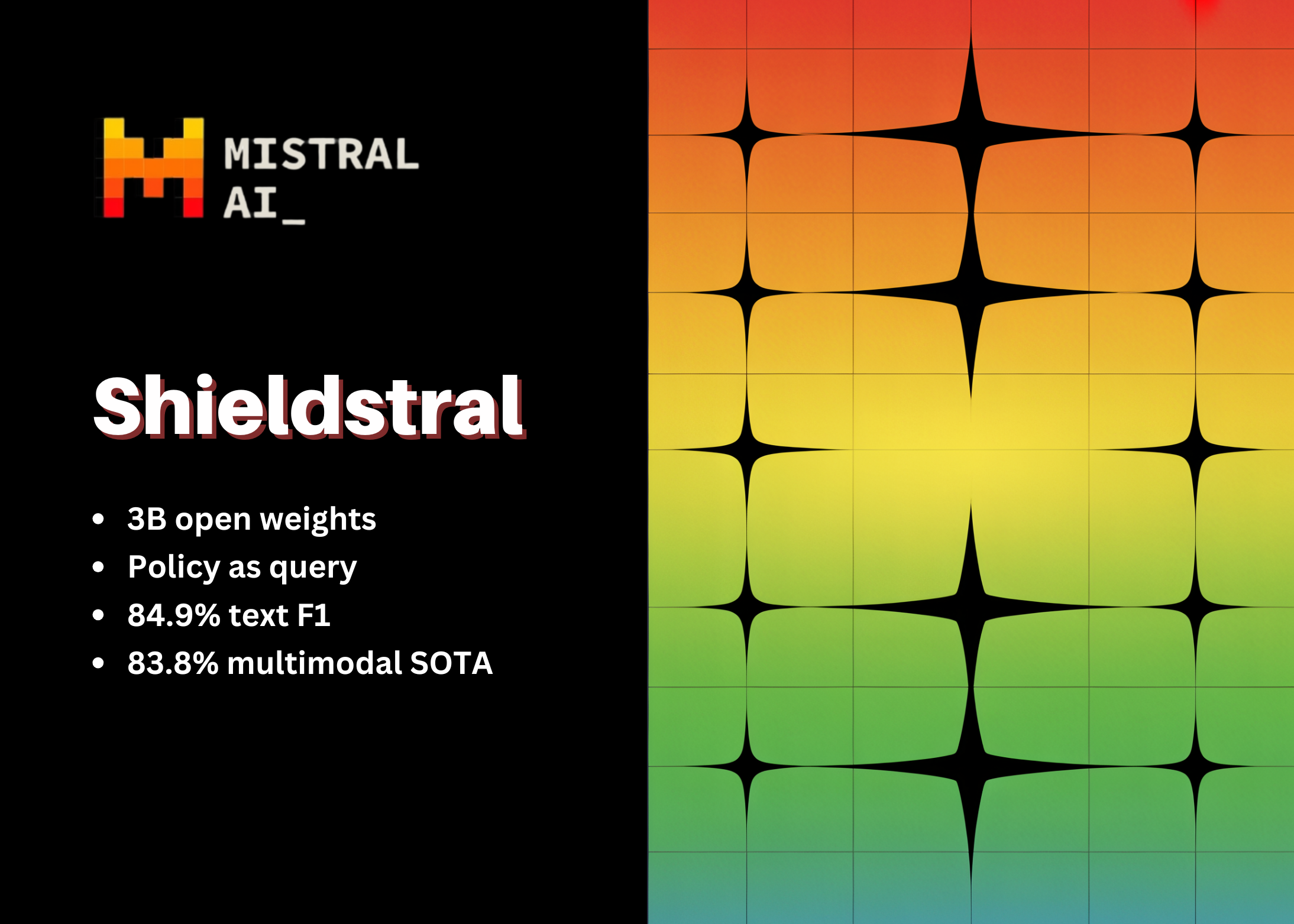

Mistral AI has launched Shieldstral 1.0 3B, an open-weights, policy-adaptive multimodal security classifier that treats content material moderation as a single sure/no query somewhat than a set taxonomy of hurt classes. Most guardrail fashions bake their class record into the weights, so re-targeting one to a brand new deployment context means retraining — and the identical content material may be acceptable on a cybersecurity analysis device whereas being dangerous on a mental-health platform. Shieldstral inverts that: operators write the coverage as a plain-language query at inference time, and the mannequin returns a calibrated security rating from a single ahead cross. Constructed on Ministral-3-3B-Base-2512 with a local Pixtral imaginative and prescient encoder and launched beneath Apache 2.0, it studies 84.9% common F1 on textual content security — matching GPT-OSS-Safeguard-20B — and 83.8% on multimodal security, forward of each baseline Mistral evaluated.
Is it deployable?
Sure, and domestically. Shieldstral-1.0-3B suits in 16GB of VRAM in BF16, runs on a single GPU, and is licensed Apache 2.0 for industrial and non-commercial use. Serving paths are already in place: vLLM (≥0.26.0, advisable), llama.cpp by way of GGUF conversion with Q8_0/Q5_K_M/Q4_K_M quantization, SGLang, and Transformers — with fine-tuning supported by means of Axolotl. The classifier emits one token, so latency and value sit far beneath reasoning-based guards like GPT-OSS-Safeguard-20B.
- Which degree of firm: the 16GB footprint places it inside attain of seed-stage AI product groups that can’t justify a moderation vendor contract, whereas the open license and self-hosting story go well with mid-market and enterprise groups that want guardrails inside a VPC or on-prem for data-residency and audit causes. Multi-tenant SaaS distributors get a particular win — one checkpoint can implement a distinct coverage per buyer.
- Industries: shopper social and UGC platforms, ed-tech and child-safety surfaces, healthcare and mental-health apps, fintech and insurance coverage help automation, gaming and voice chat, marketplaces and advert/inventive assessment, and public sector deployments with sovereignty necessities.
- Functions: user-prompt moderation, model-response moderation, refusal classification, image-plus-caption assessment for adverts and memes, training-data and RAG-corpus curation, output gating in agentic pipelines, and per-tenant coverage enforcement. As a result of the output is a steady rating somewhat than a label, groups can tune the edge per floor or route borderline scores to human assessment as an alternative of hard-blocking.
Moderation as a binary query
Shieldstral reduces moderation to at least one sure/no query. A hard and fast system message establishes the duty; the person message carries three fields: <Instruct> (analysis context and strictness), <Question> (the coverage, phrased as a single sure/no query), and <Doc> (a immediate, a response, a immediate–response pair, or a picture with non-compulsory textual content).
At inference the mannequin unembeds solely towards the sure and no token IDs and softmax-normalizes them right into a steady rating, thresholded at τ=0.5. That collapses immediate classification, response moderation, refusal detection, and toxicity detection into one downside — and it means the coverage lives totally within the immediate. Mistral’s steerage is one coverage per name; for a broad protected/unsafe verdict, record the classes in <Instruct> and ask a single extensive <Question>.
The information recipe
The claimed benefit comes from knowledge, not scale: roughly 54.1M samples — 45.2M open-source textual content, 4.4M artificial contrastive textual content, 4.5M multimodal. A template-based unification layer converts each dataset into the identical instruction–question–doc format by way of per-dataset processors, with randomized phrasings and calibrated strictness (strict for adversarial jailbreaks, lenient for response-quality knowledge).
The extra fascinating piece is contrastive technology. An LLM rewrites protected textual content into an unsafe variant that violates a goal class however intentionally not its sibling, producing a optimistic and a tough detrimental over similar content material in a single name. That teaches the mannequin which coverage is violated somewhat than a rough protected/unsafe cut up. Picture knowledge — which can’t be synthesized the way in which textual content can — is supplemented with general-purpose picture datasets as negatives, question mutation throughout a 14-subcategory visible taxonomy, and imaginative and prescient–language reranker filtering.
Coaching is LoRA fine-tuning adopted by a three-way SLERP merge: 0.6 public+generated, 0.3 public-only, 0.1 Ministral-3B-Instruct.
Outcomes
On textual content security, Shieldstral studies 84.9% common F1, tying GPT-OSS-Safeguard-20B (84.9%) because the smallest mannequin within the comparability, with wins on ToxicChat (84.1), HarmBench (99.4), and Aegis v2 response (87.2). On multimodal security it studies 83.8% general versus 77.6% for OmniGuard-7B, main VLGuard (97.7) and UnsafeBench (81.8); LlavaGuard-7B nonetheless leads its namesake benchmark at 81.4.
On the adaptability benchmark — constructed on a intentionally divergent taxonomy of 12 tremendous lessons, 26 subcategories, and 52 leaf classes with 90 fastened queries, the place no leaf maps one-to-one to coaching — Shieldstral scores 91.3% F1, behind GPT-OSS-Safeguard-20B (94.1%) and Nemotron-3.5-Security-4B (91.8%), however with out producing a reasoning hint. Refusal detection lands at 91.5% general towards 93.7% for GPT-OSS-Safeguard-20B.
The place it’s weaker: multilingual immediate classification lags on Arabic and Indonesian and on RTP-LX prompts (70.3 vs 86.1 for Nemotron-3.5-Security-4B). Mistral additionally flags diminished reliability on adversarial or obfuscated inputs and really lengthy paperwork. Skilled context is 32k tokens throughout 12 languages.
Key Takeaways
- 3B Apache 2.0 multimodal guardrail; coverage is a plain-language query at inference time, no retraining.
- 84.9% textual content F1 ties a 20B mannequin; 83.8% multimodal F1 is best-in-class amongst evaluated baselines.
- 54.1M samples with sibling-contrastive rewrites is the precise mechanism behind coverage generalization.
- Single ahead cross, single token out, steady rating at τ=0.5 — low cost sufficient for real-time gating.
- Weak spots: low-resource languages, obfuscated inputs, lengthy paperwork.
Take a look at the Paper, Mannequin on Hugging Face, and Technical Particulars. Additionally, be happy to observe us on Twitter and don’t overlook to hitch our 150k+ML SubReddit and Subscribe to our Publication. Wait! are you on telegram? now you possibly can be a part of us on telegram as nicely.
Must associate with us for selling your GitHub Repo OR Hugging Face Web page OR Product Launch OR Webinar and so forth.? Join with us
Asif Razzaq is the CEO of Marktechpost Media Inc.. As a visionary entrepreneur and engineer, Asif is dedicated to harnessing the potential of Synthetic Intelligence for social good. His most up-to-date endeavor is the launch of an Synthetic Intelligence Media Platform, Marktechpost, which stands out for its in-depth protection of machine studying and deep studying information that’s each technically sound and simply comprehensible by a large viewers. The platform boasts of over 2 million month-to-month views, illustrating its reputation amongst audiences.
