

Close Menu
  • Home
  • AI News
  • AI Startups
  • Deep Learning
  • Interviews
  • Machine-Learning
  • Robotics

Subscribe to Updates

Get the latest creative news from FooBar about art, design and business.

What's Hot

Cloud IBR Expands Automated Catastrophe Restoration from Object Storage

February 6, 2026

Suffescom Expands AI Capabilities with Launch of AI Companion Platform

February 6, 2026

Daytona Raises $24M Collection A to Give Each Agent a Pc

February 6, 2026
Facebook X (Twitter) Instagram
Smart Homez™
Facebook X (Twitter) Instagram Pinterest YouTube LinkedIn TikTok
SUBSCRIBE
  • Home
  • AI News
  • AI Startups
  • Deep Learning
  • Interviews
  • Machine-Learning
  • Robotics
Smart Homez™
Home»Deep Learning»This AI Paper Introduces PirateNets: A Novel AI System Designed to Facilitate Steady and Environment friendly Coaching of Deep Physics-Knowledgeable Neural Community Fashions
Deep Learning

This AI Paper Introduces PirateNets: A Novel AI System Designed to Facilitate Steady and Environment friendly Coaching of Deep Physics-Knowledgeable Neural Community Fashions

By February 8, 2024Updated:February 8, 2024No Comments4 Mins Read
Facebook Twitter Pinterest LinkedIn Tumblr Reddit WhatsApp Email
This AI Paper Introduces PirateNets: A Novel AI System Designed to Facilitate Steady and Environment friendly Coaching of Deep Physics-Knowledgeable Neural Community Fashions
Share
Facebook Twitter LinkedIn Pinterest WhatsApp Email


With the world of computational science regularly evolving, physics-informed neural networks (PINNs) stand out as a groundbreaking method for tackling ahead and inverse issues ruled by partial differential equations (PDEs). These fashions incorporate bodily legal guidelines into the training course of, promising a major leap in predictive accuracy and robustness. 

However as PINNs develop in depth and complexity, their efficiency paradoxically declines. This counterintuitive phenomenon stems from the intricacies of multi-layer perceptron (MLP) architectures and their initialization schemes, typically resulting in poor trainability and unstable outcomes.

Present physics-informed machine studying methodologies embody refining neural community structure, enhancing coaching algorithms, and using specialised initialization strategies. Regardless of these efforts, the seek for an optimum answer stays ongoing. Efforts resembling embedding symmetries and invariances into fashions and formulating tailor-made loss capabilities have been pivotal.

A workforce of researchers from the College of Pennsylvania, Duke College, and North Carolina State College have launched Physics-Knowledgeable Residual Adaptive Networks (PirateNets), an structure designed to harness the complete potential of deep PINNs. By submitting adaptive residual connections, PirateNets presents a dynamic framework that enables the mannequin to start out as a shallow community and progressively deepen throughout coaching. This revolutionary method addresses the initialization challenges and enhances the community’s capability to study and generalize from bodily legal guidelines.

PirateNets integrates random Fourier options as an embedding perform to mitigate spectral bias and effectively approximate high-frequency options. This structure employs dense layers augmented with gating operations throughout every residual block, the place the ahead go includes point-wise activation capabilities coupled with adaptive residual connections. Key to their design, trainable parameters inside the skip connections modulate every block’s nonlinearity, culminating within the community’s closing output being a linear amalgamation of preliminary layer embeddings. At inception, PirateNets resemble a linear mix of foundation capabilities, enabling inductive bias management. This setup facilitates an optimum preliminary guess for the community, leveraging knowledge from numerous sources to beat deep community initialization challenges inherent in PINNs.
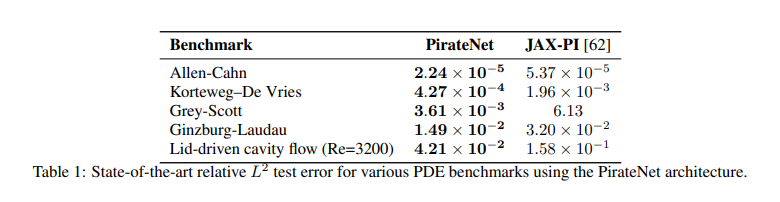
The effectiveness of PirateNet is validated by means of rigorous benchmarks, outshining Modified MLP with its refined structure. Using random Fourier options for coordinate embedding and using Modified MLP because the spine, enhanced by random weight factorization (RWF) and Tanh activation, PirateNet adheres to actual periodic boundary circumstances. The coaching makes use of mini-batch gradient descent with Adam optimizer, incorporating a studying price schedule of warm-up and exponential decay. PirateNet demonstrates superior efficiency and sooner convergence throughout benchmarks, reaching record-breaking outcomes for the Allen-Cahn and Korteweg–De Vries equations. Ablation research additional affirm its scalability, robustness, and the effectiveness of its elements, solidifying PirateNet’s prowess in successfully addressing advanced, nonlinear issues.

In conclusion, the event of PirateNets signifies a exceptional achievement in computational science. PirateNets paves the best way for extra correct and strong predictive fashions by integrating bodily ideas with deep studying. This analysis addresses the inherent challenges of PINNs and opens new routes for scientific exploration, promising to revolutionize our method to fixing advanced issues ruled by PDEs.


Take a look at the Paper and Github. All credit score for this analysis goes to the researchers of this undertaking. Additionally, don’t overlook to observe us on Twitter and Google Information. Be part of our 36k+ ML SubReddit, 41k+ Fb Neighborhood, Discord Channel, and LinkedIn Group.

For those who like our work, you’ll love our publication..

Don’t Overlook to hitch our Telegram Channel



Nikhil is an intern guide at Marktechpost. He’s pursuing an built-in twin diploma in Supplies on the Indian Institute of Know-how, Kharagpur. Nikhil is an AI/ML fanatic who’s at all times researching purposes in fields like biomaterials and biomedical science. With a robust background in Materials Science, he’s exploring new developments and creating alternatives to contribute.


🎯 [FREE AI WEBINAR] ‘Actions in GPTs: Developer Ideas, Methods & Methods’ (Feb 12, 2024)


Related Posts

How Tree-KG Allows Hierarchical Information Graphs for Contextual Navigation and Explainable Multi-Hop Reasoning Past Conventional RAG

January 27, 2026

A Coding Information to Exhibit Focused Information Poisoning Assaults in Deep Studying by Label Flipping on CIFAR-10 with PyTorch

January 11, 2026

Meet ‘kvcached’: A Machine Studying Library to Allow Virtualized, Elastic KV Cache for LLM Serving on Shared GPUs

October 26, 2025
Misa
Trending
Machine-Learning

Cloud IBR Expands Automated Catastrophe Restoration from Object Storage

By Editorial TeamFebruary 6, 20260

New compatibility lets MSPs flip low-cost object storage into recovery-ready infrastructure with out pre-staged {hardware}…

Suffescom Expands AI Capabilities with Launch of AI Companion Platform

February 6, 2026

Daytona Raises $24M Collection A to Give Each Agent a Pc

February 6, 2026

Bounteous Launches Claude Code Lab Sequence in Partnership with Anthropic to Speed up Accountable AI Adoption

February 6, 2026
Stay In Touch
  • Facebook
  • Twitter
  • Pinterest
  • Instagram
  • YouTube
  • Vimeo
Our Picks

Cloud IBR Expands Automated Catastrophe Restoration from Object Storage

February 6, 2026

Suffescom Expands AI Capabilities with Launch of AI Companion Platform

February 6, 2026

Daytona Raises $24M Collection A to Give Each Agent a Pc

February 6, 2026

Bounteous Launches Claude Code Lab Sequence in Partnership with Anthropic to Speed up Accountable AI Adoption

February 6, 2026

Subscribe to Updates

Get the latest creative news from SmartMag about art & design.

The Ai Today™ Magazine is the first in the middle east that gives the latest developments and innovations in the field of AI. We provide in-depth articles and analysis on the latest research and technologies in AI, as well as interviews with experts and thought leaders in the field. In addition, The Ai Today™ Magazine provides a platform for researchers and practitioners to share their work and ideas with a wider audience, help readers stay informed and engaged with the latest developments in the field, and provide valuable insights and perspectives on the future of AI.

Our Picks

Cloud IBR Expands Automated Catastrophe Restoration from Object Storage

February 6, 2026

Suffescom Expands AI Capabilities with Launch of AI Companion Platform

February 6, 2026

Daytona Raises $24M Collection A to Give Each Agent a Pc

February 6, 2026
Trending

Bounteous Launches Claude Code Lab Sequence in Partnership with Anthropic to Speed up Accountable AI Adoption

February 6, 2026

Domino Information Lab Names Former Joint Chiefs of Workers Vice Chair Admiral Christopher Grady to Board to Advance Public Sector AI Efforts

February 6, 2026

Novoslo Based by Keenan Torcato and Shannon Torcato to Assist Companies Implement Scalable AI Transformation

February 6, 2026
Facebook X (Twitter) Instagram YouTube LinkedIn TikTok
  • About Us
  • Advertising Solutions
  • Privacy Policy
  • Terms
  • Podcast
Copyright © The Ai Today™ , All right reserved.

Type above and press Enter to search. Press Esc to cancel.