

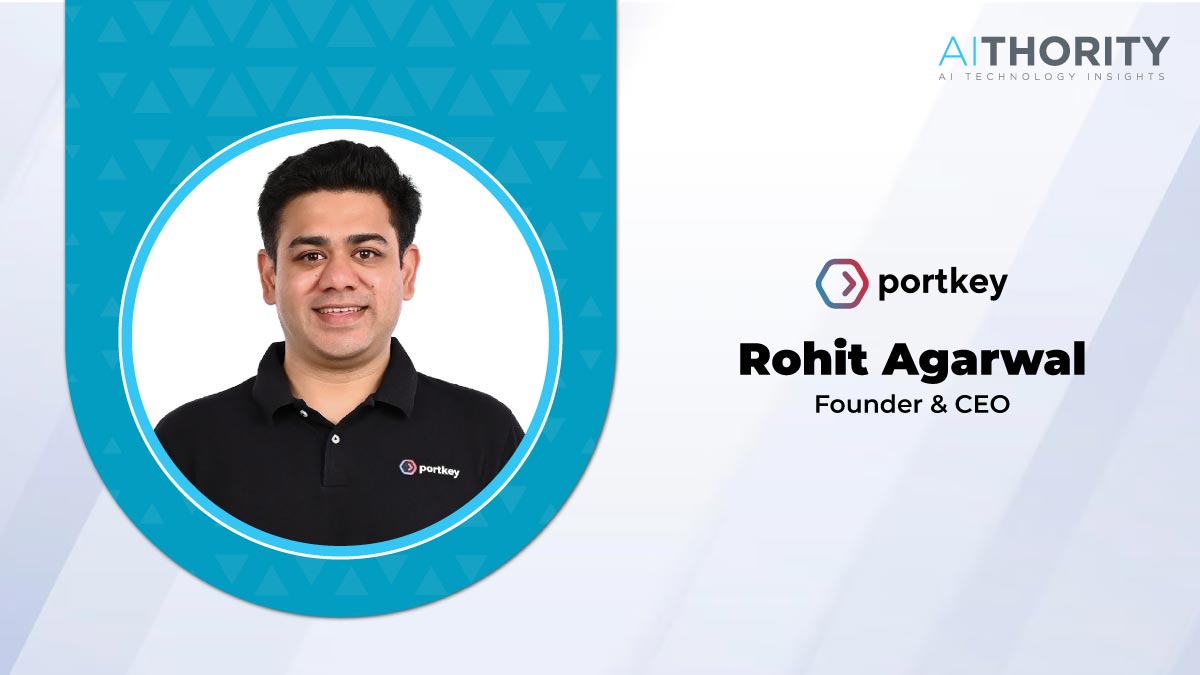

Rohit Agarwal, Founder and CEO of Portkey
chats about the advantages of unified management planes on this meet up with AiThority:
________
Hello Rohit, inform us about Portkey and the journey round your current funding.
After we began Portkey three years in the past, the AI dialog was virtually fully about fashions — which one was smarter, quicker, much less susceptible to hallucinations. We had been occupied with one thing much less glamorous: what occurs after an organization decides to really run AI in manufacturing? Who handles the API failures, the speed limits, the spend? We constructed Portkey for the second when an organization realizes its whole operation now will depend on a system it may well’t totally see or management.
Since then, our group has been arduous at work to create an AI management airplane for the enterprise. Already, we course of over 1Trillion tokens and 150M+ AI requests each day and handle over $1M+ million in each day AI spend. We assist 24,000+ organizations worldwide, together with Fortune 500 enterprises throughout finance, pharma, and expertise.
Our $15 million Sequence A funding was an enormous milestone for us, actually solidifying the worth of that preliminary imaginative and prescient and serving to us to proceed our momentum. This capital will assist us scale our infrastructure and proceed strengthening the governance layers essential for the subsequent frontier: autonomous agentic workflows that require even stricter reliability and finances guardrails.
What product targets and improvements would you want to debate on this chat, those who finish customers can sit up for within the instrument by way of 2026?
Our north star for 2026 is easy: make production-grade AI governance accessible to each group, not simply those with sufficiently big budgets to afford it.
We’ve taken a significant step this 12 months to make manufacturing AI infrastructure accessible: we open-sourced our enterprise-grade Gateway, bringing governance, observability, authentication, and price controls right into a single, unified layer obtainable to each group. This launch additionally contains the MCP Gateway, extending that very same basis to how AI brokers work together with exterior instruments and techniques.
The thought is easy: as brokers start to question databases, set off workflows, and take motion throughout enterprise environments, these interactions must be ruled, observable, and safe by default — with one gateway that sits within the path of each request.
Additionally Learn: AiThority Interview with Glenn Jocher, Founder & CEO, Ultralytics
The larger guess is on agentic governance. The business is quickly transferring previous AI-as-chatbot towards autonomous brokers that truly do issues — entry information, execute transactions, make selections with actual penalties. That multiplies the danger floor in methods most organizations aren’t ready for. We’re constructing real-time governance & resiliency — so brokers can function with full autonomy exactly as a result of the infrastructure round them is inherently safe, observable, and accountable. The aim isn’t to gradual brokers down. It’s to make them protected sufficient to actually let go.
How are unified management planes extra useful for enterprise-grade AI?
Right here’s the sample we see again and again: an organization begins with one group operating one mannequin for one use case. Inside a 12 months, there are forty groups, six mannequin suppliers, no shared safety posture, and no one who can reply the query “how a lot are we spending on AI?” with out a two-week audit. It’s a pure consequence of decentralized innovation, nevertheless it turns into ungovernable quick.
A unified management airplane solves this by sitting instantly within the path of all AI site visitors — not as a bolt-on dashboard, however as an energetic layer by way of which each request flows. Engineering will get reliability: clever routing, automated failover, latency optimization. Finance will get accountability: real-time spend monitoring, finances enforcement, chargeback attribution. And management will get solutions — which is usually the toughest factor to return by.
The actual energy is in what “in-path” means operationally. It means you’ll be able to implement information insurance policies in real-time — stopping proprietary data from leaving the group — with out counting on people to recollect the foundations. It signifies that when a supplier goes down or modifications their pricing in a single day, the management airplane handles the failover or value optimization routinely, and business-critical features maintain operating with out anybody having to scramble. AI stops being a group of fragile, disconnected API calls and begins behaving like a managed utility — which is what it must be if it’s going to be load-bearing infrastructure.
As corporations look to combine an AI layer throughout most features, what ideas and greatest practices ought to they have in mind?
First — set up governance and finances guardrails earlier than you scale, not after. It’s considerably more durable to retroactively claw again AI entry or safe information as soon as it has already permeated a company. Centralized LLM supplier administration and automatic value controls must be desk stakes from the beginning, not an afterthought.
Second — plan for multi-model complexity. The perfect mannequin immediately could also be out of date in six months, and the truth is that the majority enterprises are already operating a number of fashions throughout a number of groups for a number of use circumstances — picture technology, code completion, customer-facing chat. Every one you add will increase operational complexity and the floor space for failure. Constructing on a versatile, provider-agnostic layer ensures you’re not locked into any single ecosystem and that reliability doesn’t degrade as you scale.
Lastly, take into consideration entry at scale early. One factor we see persistently is that AI begins in pockets: one group, one use case. Then instantly the query turns into, how do you roll this out to a thousand engineers, or ten thousand workers, with out chaos? That transition from particular person experimentation to org-wide deployment is the place a variety of corporations get caught flat-footed.
Are you able to discuss a number of the most modern AI developments from around the globe which have piqued your curiosity and why?
What fascinates me most proper now could be the emergence of AI agent patterns that truly work — not as demos, not as analysis previews, however as instruments individuals use day-after-day and construct actual workflows round. We’ve spent years speaking about autonomous brokers within the summary. In 2026, they arrived.
Take Claude Code, Anthropic’s agentic coding instrument. It doesn’t simply recommend code — it reads your whole codebase, plans multi-step modifications throughout information, runs assessments, opens PRs, and iterates by itself output. Apple simply built-in it into Xcode. Builders are utilizing it to ship whole options whereas they sleep. That’s not autocomplete. That’s an agent with real autonomy working inside knowledgeable workflow, with the guardrails to make it protected. It represents a brand new sample: AI that’s deeply embedded in a developer’s current toolchain, working with full context of the challenge, and taking consequential actions — not simply producing textual content.
Then there’s OpenClaw — the open-source private AI agent that went from an Austrian developer’s aspect challenge to 247,000 GitHub stars and adoption from Silicon Valley to Shenzhen in a matter of weeks. OpenClaw runs regionally, connects to your messaging apps, calendars, and file techniques, and executes duties autonomously with persistent reminiscence. Persons are utilizing it to handle emails, automate workflows, and even construct purposes by way of pure language dialog on WhatsApp. Jensen Huang referred to as it probably the most vital software program releases ever. Chinese language tech giants are constructing whole product suites on prime of it. A neighborhood authorities in Shenzhen has drafted coverage to assist its adoption.
However right here’s why these developments are so fascinating from an infrastructure perspective: each Claude Code and OpenClaw expose precisely the governance hole we’ve been speaking about. These brokers have system-level entry — they’ll learn information, execute instructions, spend cash, and work together with exterior providers. OpenClaw has already confronted safety incidents, immediate injection vulnerabilities, and consent controversies. The extra succesful and autonomous brokers change into, the extra vital it’s to have an infrastructure layer that governs what they’ll entry, what they’ll do, and what occurs when one thing goes fallacious. The agent period isn’t coming — it’s right here. And the infrastructure to make it protected at enterprise scale is the pressing, unsolved drawback.
For groups to make the AI they use or the AI workflows they construct extra truthful and accountable: what must be stored in thoughts?
Constructing truthful and accountable AI requires treating each AI interplay as one thing price auditing.
The very first thing groups ought to put in place is complete logging and a scientific audit path. Each resolution an AI system makes must be traceable again to the particular request, the mannequin model used, and the info it accessed. When one thing drifts or hallucinates — and it’ll — you shouldn’t should guess why. That stage of granular visibility transforms failures from embarrassing surprises into predictable information factors you’ll be able to truly be taught from and repair.
The second is real-time guardrails within the vital path of your site visitors. Run automated checks to scan outputs for delicate information, toxicity, or factual inconsistencies earlier than they attain an finish consumer. A governance layer that sits between your fashions and your customers creates a security web that operates repeatedly.
The third — and this one will get ignored — is entry governance. Accountability isn’t nearly what the AI outputs. It’s about who has entry to what, underneath what circumstances, and whether or not you’ll be able to revoke that entry immediately if one thing goes fallacious. As AI rolls out throughout a whole group, the query of who licensed what turns into simply as vital as what the mannequin truly stated.
Finally, accountability is an infrastructure drawback as a lot as it’s a mannequin drawback. You possibly can have essentially the most correct mannequin on the planet and nonetheless haven’t any accountability for those who can’t see what it’s doing.
5 final ideas on AI earlier than we wrap up?
-
AI is now the load-bearing wall:
AI is now not a aspect challenge or a shiny demo; it has change into a load-bearing wall for contemporary enterprise operations. When your buyer assist, underwriting, and dev instruments run on LLMs, organizations can’t afford to dismiss failures as “bugs” once they could cause business-threatening outages.
-
The largest AI challenges are literally engineering challenges:
Whereas the media focuses on hallucinations and bias, the real-world killers of AI tasks are fundamental infrastructure gaps like fee limits, silent API failures, supplier volatility, and runaway spend. Success isn’t about having one of the best mannequin; it’s about having essentially the most resilient system to run it.
-
Governance is the key to velocity:
There’s an assumption baked into most engineering cultures that governance slows you down — that safety opinions, entry controls, and finances oversight are the tax you pay for doing issues responsibly. In manufacturing AI, that logic inverts. When groups have a unified management airplane that handles safety, value accountability, and information privateness routinely, they ship quicker — as a result of they’re not afraid of breaking the financial institution or the legislation.
-
The “agentic frontier” requires a brand new command middle:
With autonomous brokers that may spend budgets and make selections, the necessity for management turns into non-negotiable. Organizations want a single layer that not solely observes what AI is doing but additionally governs what it may well and might’t do in real-time.
-
The winners would be the corporations that cease chasing the chaos.
The AI panorama modifications weekly. New fashions, fluctuating costs, sudden deprecations — that’s the one fixed. The businesses that thrive gained’t be those constructing customized fixes for each replace. They’ll be those with a single, secure infrastructure layer that absorbs the chaos so their groups don’t should.
Additionally Learn: The Infrastructure Conflict Behind the AI Increase
[To share your insights with us, please write to psen@itechseries.com ]
Portkey is the manufacturing management airplane for AI that by no means breaks: a unified platform that sits within the path of each mannequin request and agent motion to offer governance, observability, reliability, and price management. As AI turns into vital infrastructure, Portkey offers engineering groups operational reliability whereas giving finance groups real-time visibility and accountability. Trusted by Fortune 500 enterprises throughout finance, pharma, and expertise, Portkey manages greater than $1M in LLM spend day-after-day, governing greater than 1 Trillion tokens per day. Backed by Elevation Capital and Lightspeed, Portkey is headquartered in San Francisco, CA.
Rohit Agarwal is the Founder and CEO of Portkey, Rohit is a two-time founder and product chief who began his first firm straight out of college, which was later acquired by Freshworks. He went on to guide product and platform at Freshworks, serving to construct Freshdesk and a number of other AI-driven merchandise at international scale. Rohit later headed product at Pepper Content material, the place he constructed an AI content material platform that reached over 500,000 customers. The tooling challenges he encountered constructing AI purposes at scale instantly impressed the creation of Portkey in 2023. Portkey just lately raised a $15 million Sequence A led by Elevation Capital with participation from Lightspeed.
