

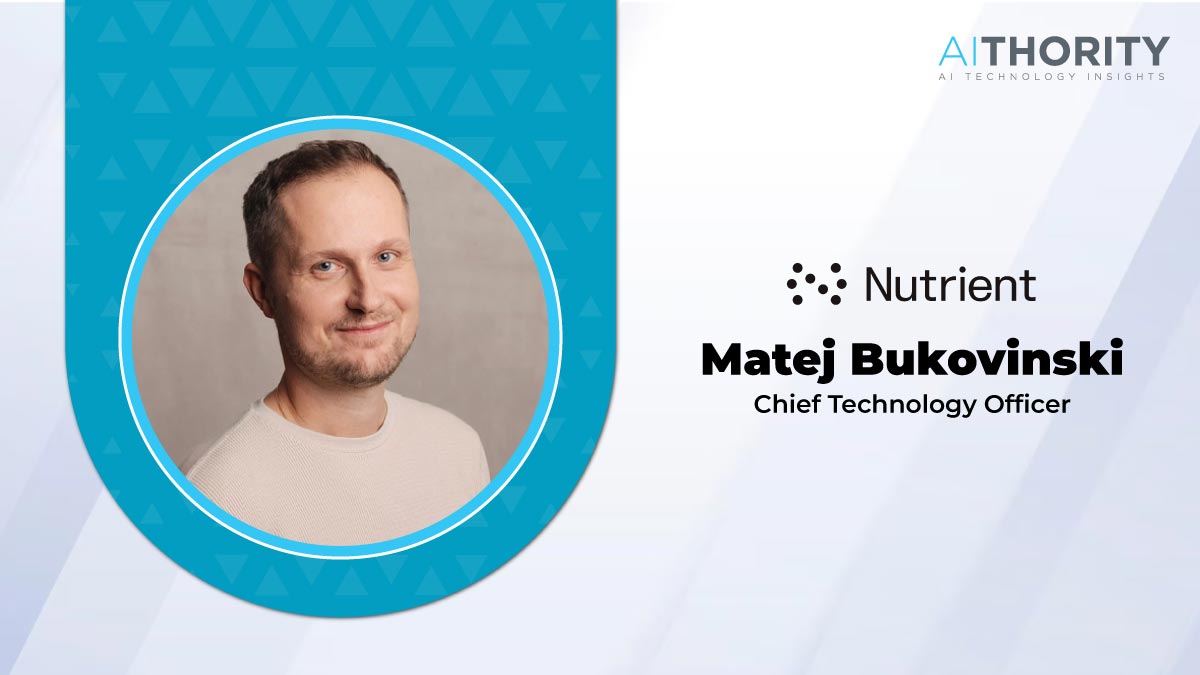

Matej Bukovinski, Chief Expertise Officer at Nutrient chats in regards to the evolving abilities fashionable software program builders want in an AI pushed coding ecosystem:
_______
Are you able to inform us about Nutrient’s newest AI assistant and the way it’s altering the sport for finish customers?
For years, paperwork, particularly ones in transportable codecs such a PDF, have been probably the most static a part of any digital workflow. You may automate nearly all the things else, however the second a PDF contract enters the image, somebody has to cease and do guide work. That’s the issue we got down to remedy.
We just lately shipped a significant replace to Nutrient AI Assistant that provides an autonomous doc enhancing agent alongside the prevailing chat agent. The chat agent lets customers ask questions, get summaries, and translate content material — primarily turning any doc right into a dialog. The enhancing agent goes additional: you describe what you want in pure language — “extract all legal responsibility caps from this contract,” “redact affected person identifiers earlier than sharing with the analysis crew” — and it plans, executes, and adapts throughout a number of steps utilizing our purpose-built doc instruments for rendering, extraction, kind operations, annotation, and redaction.
What makes this completely different from bolting a chatbot onto a PDF viewer is that the agent operates beneath configurable governance. Builders can outline which actions run autonomously, which require person affirmation, and that are prohibited totally. You may inject domain-specific abilities — your organization’s compliance guidelines, pricing knowledge, validation logic — so the agent doesn’t simply work on paperwork, it really works the way in which your group works. It runs throughout net and cell, and connects to no matter LLM supplier you select — within the cloud or on premise.
Additionally Learn: AIThority Interview With Rohit Agarwal, Founder & CEO of Portkey
As builders confide in AI assistants supporting their work, how will the longer term scope of labor for a typical B2B SaaS growth crew begin to seem like?
The trustworthy reply is that the crew of the close to future appears much less like a pool of coders and extra like an engineering management group. When agentic AI handles extra of the implementation — writing code, working checks, fixing failures — the precious human work shifts to defining outcomes, designing programs, and reviewing outcomes. At Nutrient, we’ve mandated the usage of coding brokers throughout the crew: we solely write code manually as a fallback. The engineers who’ve leaned in are working at a basically completely different altitude, pondering in programs and outcomes moderately than traces and recordsdata.
For B2B SaaS groups particularly, I feel we’ll see smaller groups producing extra, with engineering judgment changing into the scarce useful resource moderately than engineering hours. Planning, structure, and the flexibility to orchestrate AI successfully will outline crew composition greater than uncooked headcount. One of the best performers within the age of AI will not be essentially going to be the identical as earlier than it.
What abilities matter most in a time of AI-driven coding?
Three issues stand out. First, communication — and I imply that actually as a technical ability. This isn’t about immediate engineering. As AI advances, being intelligent together with your wording issues much less and fewer. What does nonetheless matter is the ability of having the ability to describe an issue with sufficient precision to get a helpful end result, with out overspecifying in ways in which constrain the answer house. This in some ways separates nice engineers from the remaining proper now.
Second, programs pondering. When AI handles extra implementation, the scarce useful resource isn’t code quantity — it’s structure, contextual information, and the judgment that solely comes from having constructed and maintained actual programs at scale. These abilities matter extra when the instruments round you might be extra highly effective, not much less.
Third, vital analysis. Builders who use AI as a black field, accepting output uncritically, create a special type of downside than the one AI was supposed to resolve. The flexibility to acknowledge when the instrument is incorrect, and to push again, is essential.
Are you able to speak about a few of the challenges you foresee with builders utilizing AI with out the appropriate protocols? What would you share as prime ideas and finest practices?
The largest danger is invisible: groups that velocity up code manufacturing with out equally dashing up code assessment, testing, and launch processes simply transfer the bottleneck. You find yourself with a firehose of pull requests that no one is reviewing or testing correctly, and high quality drops.
The everyday recommendation somebody would possibly give right here is to not let AI-generated code skip human assessment. In reality moderately double down on it. Nonetheless that brings us proper again to the bottlenecks described above and to not absolutely leveraging the speedups AI guarantees.
As a substitute, make your assessment more practical by augmenting human opinions with AI tooling. From automated LLM based mostly opinions and safety checks on CI to utilizing brokers steered by people to dig into particular areas the reviewer is aware of will be problematic. That is what we apply at Nutrient. Each stage of the event lifecycle must get quicker collectively. The identical applies to QA testing, the place brokers can do exploratory testing subsequent to people or releases the place brokers can take over sprucing launch notes.
Just a few ideas on the way forward for AI?
We’re not incrementally enhancing how software program will get constructed — we’re dismantling its elementary assumptions. The notion that constructing software program requires giant, specialised groups working in lockstep over months-long cycles is changing into out of date. A single engineer with the appropriate agentic setup can now obtain what used to require a squad or engineers. This basically adjustments how engineering organizations are constructed and what abilities are being prioritized in hiring. Everybody who’s not investing is bettering themselves on this entrance is risking changing into out of date.
The software program {industry} is a frontrunner right here, however it’s clear to me that it’s solely a matter of time earlier than the identical hits different mental work. As agentic software program progresses, the precise industries that software program serves get disrupted one after the other. In that sense it’s very apparent why AI labs are investing in software program growth tooling first, to progressively lengthen their attain. Individuals who need a house on this new world must deal with this inevitability as a chance, not a risk and study methods how they’ll leverage the brand new tooling to their benefit, because it’s changing into obtainable.
Some prime AI improvements and AI innovators you’d prefer to shout out?
Anthropic’s Claude Code and OpenAI’s Codex have genuinely modified what “agentic coding” means in apply — these aren’t assistants anymore, they’re collaborators that execute throughout whole codebases. Cursor deserves credit score for proving that deep IDE integration and mannequin flexibility is what skilled builders really need. On the open-source aspect, tasks like PI (the minimal coding agent) and OpenClaw (for brokers that go nicely past code) are pushing boundaries in vital methods.
Past coding instruments, I’d spotlight what’s occurring in doc AI extra broadly. The shift from static doc processing to agentic doc workflows — the place AI doesn’t simply learn paperwork however acts on them — is a metamorphosis that’s nonetheless underappreciated. And the infrastructure layer issues too: abilities, MCP (Mannequin Context Protocol), command line instruments are quietly changing into the connective tissue that lets AI brokers work together with actual enterprise knowledge, saved in paperwork or in any other case. Shifting ahead, that’s going to be foundational for any enterprise, not simply software program retailers, which is why Nutrient will hold investing on this space.
Additionally Learn: AI-Pushed Danger Intelligence: How FIs Are Predicting Systemic Shocks
[To share your insights with us, please write to psen@itechseries.com]
Nutrient is the doc intelligence firm remodeling how fashionable companies convert info into worth. By unifying industry-leading SDKs with agentic AI and document-centric workflow automation, Nutrient empowers hundreds of world organizations to show static recordsdata into clever, executable enterprise property. From safe software growth to enterprise-wide automation, Nutrient ensures that paperwork are now not bottlenecks, however lively drivers of progress, compliance, and innovation.
Matej is a software program engineering chief from Slovenia. He started his profession freelancing and contributing to open-source software program. Later, he joined Nutrient, the place he performed a key position in creating its preliminary merchandise and groups, ultimately taking up as the corporate’s Chief Expertise Officer. Outdoors of labor, Matej enjoys taking part in tennis, snowboarding, and touring.
