
Earth statement (EO) constellations seize large volumes of high-resolution imagery daily, however most of it by no means reaches the bottom in time for mannequin coaching. Downlink bandwidth is the principle bottleneck. Pictures can sit on orbit for days whereas floor fashions prepare on partial and delayed knowledge.
Microsoft Researchers launched ‘OrbitalBrain’ framework as a distinct strategy. As an alternative of utilizing satellites solely as sensors that relay knowledge to Earth, it turns a nanosatellite constellation right into a distributed coaching system. Fashions are skilled, aggregated, and up to date instantly in house, utilizing onboard compute, inter-satellite hyperlinks, and predictive scheduling of energy and bandwidth.
The BentPipe Bottleneck
Most business constellations use the BentPipe mannequin. Satellites gather photos, retailer them domestically, and dump them to floor stations each time they cross overhead.
The analysis workforce evaluates a Planet-like constellation with 207 satellites and 12 floor stations. At most imaging fee, the system captures 363,563 photos per day. With 300 MB per picture and reasonable downlink constraints, solely 42,384 photos may be transmitted in that interval, round 11.7% of what was captured. Even when photos are compressed to 100 MB, solely 111,737 photos, about 30.7%, attain the bottom inside 24 hours.
Restricted onboard storage provides one other constraint. Outdated photos should be deleted to make room for brand spanking new ones, which suggests many doubtlessly helpful samples are by no means accessible for ground-based coaching.
Why Standard Federated Studying isn’t Sufficient
Federated studying (FL) looks as if an apparent match for satellites. Every satellite tv for pc might prepare domestically and ship mannequin updates to a floor server for aggregation. The analysis workforce consider a number of FL baselines tailored to this setting:
- AsyncFL
- SyncFL
- FedBuff
- FedSpace
Nevertheless, these strategies assume extra secure communication and extra versatile energy than satellites can present. When the analysis workforce simulate reasonable orbital dynamics, intermittent floor contact, restricted energy, and non-i.i.d. knowledge throughout satellites, these baselines present unstable convergence and huge accuracy drops, within the vary of 10%–40% in comparison with idealized circumstances.
The time-to-accuracy curves flatten and oscillate, particularly when satellites are remoted from floor stations for lengthy intervals. Many native updates turn out to be stale earlier than they are often aggregated.
OrbitalBrain: Constellation-Centric Coaching in House
OrbitalBrain begins from 3 observations:
- Constellations are often operated by a single business entity, so uncooked knowledge may be shared throughout satellites.
- Orbits, floor station visibility, and solar energy are predictable from orbital components and energy fashions.
- Inter-satellite hyperlinks (ISLs) and onboard accelerators at the moment are sensible on nano-satellites.
The framework exposes 3 actions for every satellite tv for pc in a scheduling window:
- Native Compute (LC): prepare the native mannequin on saved photos.
- Mannequin Aggregation (MA): change and combination mannequin parameters over ISLs.
- Knowledge Switch (DT): change uncooked photos between satellites to cut back knowledge skew.
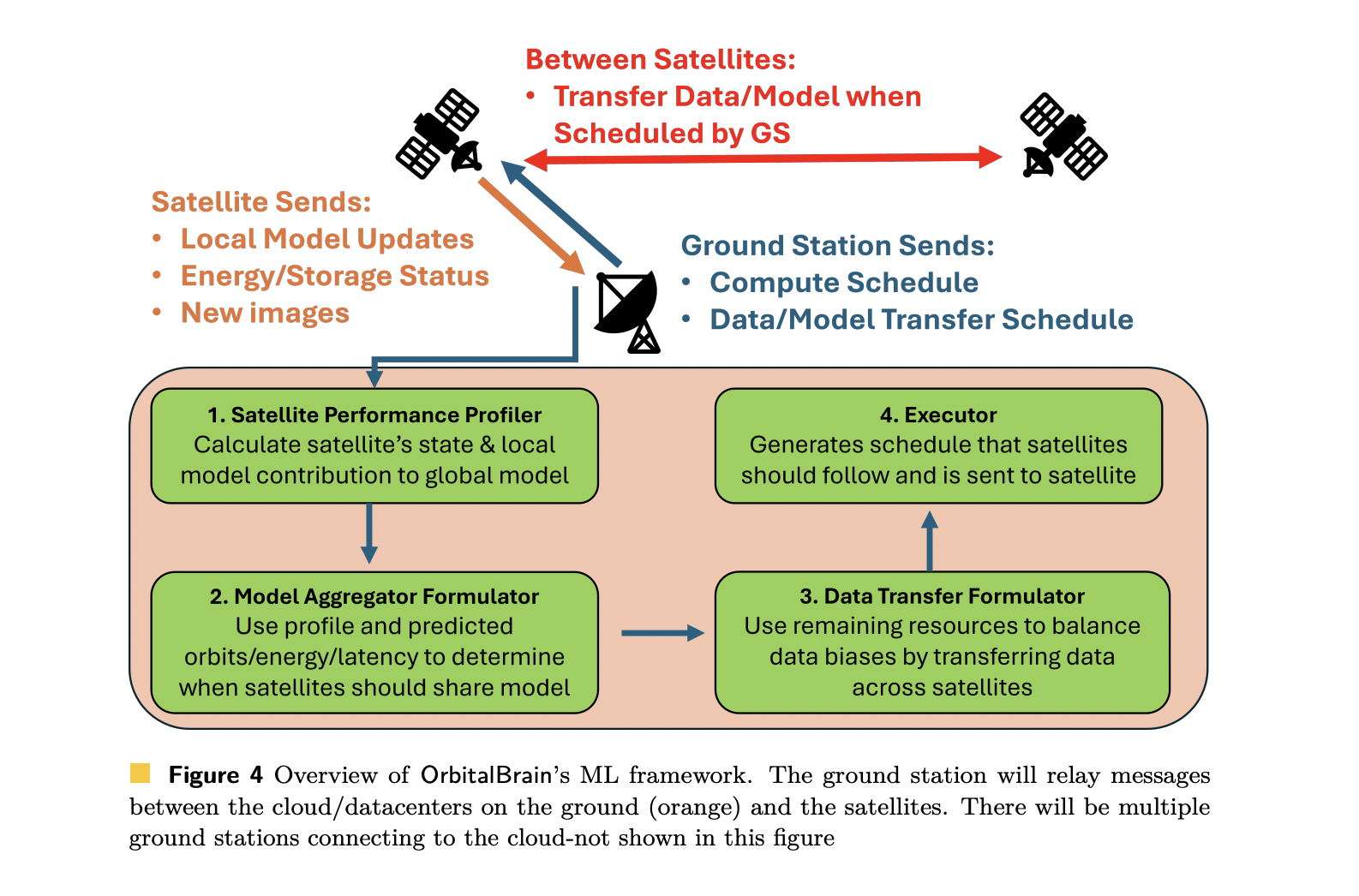
A controller operating within the cloud, reachable through floor stations, computes a predictive schedule for every satellite tv for pc. The schedule decides which motion to prioritize in every future window, based mostly on forecasts of vitality, storage, orbital visibility, and hyperlink alternatives.
Core Parts: Profiler, MA, DT, Executor
- Guided efficiency profiler
- Mannequin aggregation over ISLs
- Knowledge transferrer for label rebalancing
- Executor
Experimental setup
OrbitalBrain is carried out in Python on high of the CosmicBeats orbital simulator and the FLUTE federated studying framework. Onboard compute is modeled as an NVIDIA-Jetson-Orin-Nano-4GB GPU, with energy and communication parameters calibrated from public satellite tv for pc and radio specs.
The analysis workforce simulate 24-hour traces for two actual constellations:
- Planet: 207 satellites with 12 floor stations.
- Spire: 117 satellites.
They consider 2 EO classification duties:
- fMoW: round 360k RGB photos, 62 courses, DenseNet-161 with the final 5 layers trainable.
- So2Sat: round 400k multispectral photos, 17 courses, ResNet-50 with the final 5 layers trainable.
Outcomes: sooner time-to-accuracy and better accuracy
OrbitalBrain is in contrast with BentPipe, AsyncFL, SyncFL, FedBuff, and FedSpace beneath full bodily constraints.
For fMoW, after 24 hours:
- Planet: OrbitalBrain reaches 52.8% top-1 accuracy.
- Spire: OrbitalBrain reaches 59.2% top-1 accuracy.
For So2Sat:
- Planet: 47.9% top-1 accuracy.
- Spire: 47.1% top-1 accuracy.
These outcomes enhance over the perfect baseline by 5.5%–49.5%, relying on dataset and constellation.
When it comes to time-to-accuracy, OrbitalBrain achieves 1.52×–12.4× speedup in comparison with state-of-the-art ground-based or federated studying approaches. This comes from utilizing satellites that can’t at the moment attain a floor station by aggregating over ISLs and from rebalancing knowledge distributions through DT.
Ablation research present that disabling MA or DT considerably degrades each convergence velocity and closing accuracy. Further experiments point out that OrbitalBrain stays strong when cloud cowl hides a part of the imagery, when solely a subset of satellites take part, and when picture sizes and resolutions fluctuate.
Implications for satellite tv for pc AI workloads
OrbitalBrain demonstrates that mannequin coaching can transfer into house and that satellite tv for pc constellations can act as distributed ML programs, not simply knowledge sources. By coordinating native coaching, mannequin aggregation, and knowledge switch beneath strict bandwidth, energy, and storage constraints, the framework allows brisker fashions for duties like forest fireplace detection, flood monitoring, and local weather analytics, with out ready days for knowledge to achieve terrestrial knowledge facilities.
Key Takeaways
- BentPipe downlink is the core bottleneck: Planet-like EO constellations can solely downlink about 11.7% of captured 300 MB photos per day, and about 30.7% even with 100 MB compression, which severely limits ground-based mannequin coaching.
- Commonplace federated studying fails beneath actual satellite tv for pc constraints: AsyncFL, SyncFL, FedBuff, and FedSpace degrade by 10%–40% in accuracy when reasonable orbital dynamics, intermittent hyperlinks, energy limits, and non-i.i.d. knowledge are utilized, resulting in unstable convergence.
- OrbitalBrain co-schedules compute, aggregation, and knowledge switch in orbit: A cloud controller makes use of forecasts of orbit, energy, storage, and hyperlink alternatives to pick Native Compute, Mannequin Aggregation through ISLs, or Knowledge Switch per satellite tv for pc, maximizing a utility perform per motion.
- Label rebalancing and mannequin staleness are dealt with explicitly: A guided profiler tracks mannequin staleness and loss to outline compute utility, whereas the information transferrer makes use of Jensen–Shannon divergence on label histograms to drive raw-image exchanges that scale back non-i.i.d. results.
- OrbitalBrain delivers increased accuracy and as much as 12.4× sooner time-to-accuracy: In simulations on Planet and Spire constellations with fMoW and So2Sat, OrbitalBrain improves closing accuracy by 5.5%–49.5% over BentPipe and FL baselines and achieves 1.52×–12.4× speedups in time-to-accuracy.
Take a look at the Paper. Additionally, be at liberty to comply with us on Twitter and don’t neglect to affix our 100k+ ML SubReddit and Subscribe to our Publication. Wait! are you on telegram? now you possibly can be a part of us on telegram as properly.